





ATM Software Update Challenges Explained

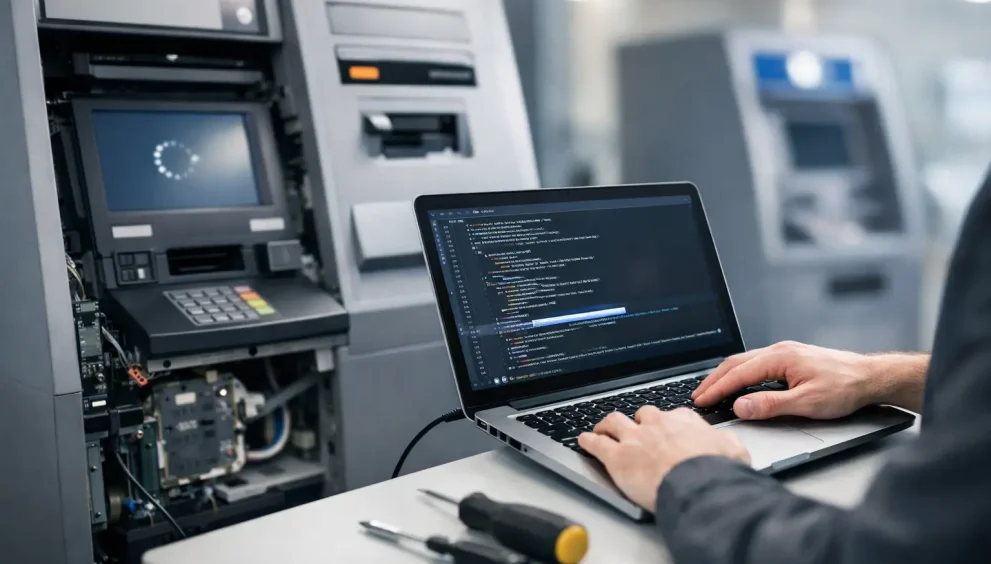
A failed patch at 2 a.m. rarely stays a software issue for long. By morning, it becomes a truck roll, a customer complaint, a balancing exception, and a question from management about why a routine change created avoidable downtime. That is why atm software update challenges remain a persistent operational issue across banking and self-service fleets.
For most operators, the difficulty is not the update itself. It is the mix of aging hardware, distributed communications, vendor dependencies, security controls, and limited maintenance windows that turns a standard software task into a fleet management problem. ATMs sit at the intersection of endpoint computing, transaction security, cash handling, and physical service operations. Updating them means dealing with all four at once.
Why ATM software update challenges are different
An ATM is not just another remote endpoint. A software change can affect the application stack, the operating system, device middleware, encrypted communications, journal handling, card reader behavior, dispenser controls, and remote monitoring tools. In many fleets, those layers were not all installed at the same time or by the same provider.
That matters because update risk is cumulative. A bank may believe it is deploying a simple security patch, but the patch may interact with older XFS middleware, a customized ATM application, or device drivers that have not been tested against the current image. The result may not be a total failure. More often, it is a partial fault – receipt printer issues, cash unit communication errors, frozen screens, or terminals that remain online but can no longer complete transactions consistently.
This is one reason ATM estates with mixed vintages are harder to manage than standardized fleets. Uniformity lowers the testing burden. Heterogeneity expands it quickly.
Legacy hardware makes every update harder
A large share of ATM software update challenges starts with hardware that remains operational but no longer fits current software expectations. Many terminals in the field were deployed under assumptions about processor capacity, memory, storage, and operating system support that no longer hold up well against modern security and application requirements.
On paper, the machine still works. In practice, the available headroom is narrow. Installing an updated image may increase boot times, consume more disk space, or expose component-level instability that had gone unnoticed for years. This often creates a difficult decision for operators. They can delay updates and carry more security and compliance risk, or they can force software modernization onto equipment that is already near the end of its practical life.
Neither option is ideal. For fleet owners under budget pressure, extending terminal life may look efficient. But repeated exceptions, field workarounds, and failed update recoveries can erase those savings over time.
The hidden cost of customization
Customization adds another layer of complexity. Many ATM fleets do not run vendor-default software builds. They run locally adapted images shaped by sponsor bank requirements, EFT switch integrations, branding rules, accessibility settings, transaction menus, and device-specific service logic.
Those customizations often make business sense. They can also create long-term maintenance friction. A standard vendor patch may require retesting across multiple variants, and even small application changes can trigger certification work with processors, security teams, or network operators. The more unique the implementation, the less likely it is that updates can be pushed quickly and uniformly.
Network and scheduling constraints are easy to underestimate
Remote software distribution sounds straightforward until it meets field conditions. Some ATMs still operate on bandwidth-constrained or unstable links. Others sit behind segmented security architectures that intentionally limit remote access pathways. In both cases, the update process can become slow, fragmented, or vulnerable to interruption.
Timing is another issue. Maintenance windows for ATMs are usually narrow, especially in high-traffic retail or branch environments. Updates need to avoid customer usage peaks, armored service visits, cash replenishment schedules, and other planned work. If a deployment overruns the maintenance window or leaves the terminal in a non-transactional state, operations teams may have to choose between extending downtime or dispatching a technician.
This is where central planning often diverges from field reality. A rollout that looks efficient at the fleet level may create localized service strain if too many terminals in one market fail validation at the same time.
Testing is where many update programs win or fail
The most common operational mistake is not patching too often. It is assuming that pre-deployment testing was broad enough when it was not. A lab environment can verify basic functionality, but it rarely reproduces the full variability of an installed fleet.
Real-world ATM testing has to account for hardware generations, peripheral combinations, communication types, local configurations, and transaction flows tied to specific institutions or processors. It also needs to include recovery behavior. A terminal that updates successfully but does not recover cleanly after power interruption is still a deployment risk.
What effective testing usually includes
Strong testing programs usually move in phases rather than one large push. They validate software behavior in the lab, then in a controlled pilot, then in a limited production segment before broad deployment. That sounds conservative, but in ATM operations it is usually cheaper than mass rollback.
The practical challenge is time. Security teams may want faster patch cycles, while operations teams need confidence that the update will not increase incident volume. Both priorities are valid. The right balance depends on the nature of the update, the fleet profile, and the ability to isolate problems quickly if they appear.
Security controls can complicate maintenance
Security is a major reason updates happen, but security architecture can also make those updates harder to execute. Application whitelisting, certificate controls, privileged access restrictions, encrypted distribution channels, and endpoint hardening measures all reduce risk. They also increase procedural dependency.
A missed certificate, expired credential, or policy mismatch can stop an installation before it starts. In more tightly controlled environments, even authorized teams may need multiple approvals to deliver an updated package, validate hashes, or restart services. That is understandable from a security perspective, but it can slow response times when urgent remediation is needed.
There is a trade-off here that operators know well. Stronger controls reduce exposure, but they also reduce flexibility. Organizations that handle this well usually invest in disciplined change management rather than trying to bypass controls during high-pressure events.
Vendor coordination is often the real bottleneck
Many ATM software update challenges are not purely technical. They are organizational. A single update may involve the ATM manufacturer, the application provider, middleware suppliers, a managed service partner, the host processor, and the bank’s internal infrastructure and security teams.
When roles are clear, updates move predictably. When ownership is fragmented, basic questions can delay a rollout. Who signs off on peripheral driver changes? Who validates compatibility with the monitoring stack? Who owns rollback criteria if transaction errors rise after deployment? These are not abstract governance questions. They determine whether a problem is contained in hours or drifts across multiple service cycles.
This is especially relevant in outsourced or partially outsourced environments. Managed service models can improve consistency, but they can also create blind spots if contractual boundaries do not match operational realities.
Reducing field risk without freezing modernization
The practical goal is not zero-risk updating. That is unrealistic in a live ATM estate. The goal is to reduce failure rates, shorten recovery time, and avoid introducing instability at scale.
That usually starts with better fleet segmentation. Operators need a current picture of which terminals share hardware profiles, software baselines, peripheral versions, and communication dependencies. Without that visibility, rollout plans tend to treat the fleet as more uniform than it really is.
It also helps to define update classes. A critical security patch, a middleware revision, a UI change, and a full image refresh should not all follow the same approval or deployment path. The operational risk is different in each case, so the process should be different as well.
Recovery planning deserves equal weight. Teams often focus heavily on deployment success and less on failed-state handling. Yet in the field, the quality of the rollback process may matter more than the speed of the initial push. If a terminal can be restored remotely and predictably, the business impact stays manageable. If not, every failure becomes a service event.
Why modernization strategy matters
Over time, ATM software update challenges become a signal rather than a standalone problem. Frequent patch friction usually points to deeper issues in fleet standardization, lifecycle discipline, vendor alignment, or infrastructure design.
That is why update performance should be viewed as an operational health metric. Fleets that are hard to patch are often hard to secure, hard to support, and expensive to modernize. By contrast, fleets with standardized images, disciplined configuration control, and clear update governance tend to perform better across uptime, compliance, and service cost.
For banks and deployers planning the next phase of self-service investment, that is the larger lesson. Software updates should not be treated as background maintenance. They are one of the clearest tests of whether the ATM estate is actually manageable under real operating conditions.
The organizations that handle updates well are usually not the ones with the most aggressive patch cadence. They are the ones that know their fleet in detail, test against field reality, and make modernization decisions before the next urgent patch forces the issue.