





ATM Service Management Best Practices

An ATM that is technically online but unable to dispense cash, read cards reliably, or complete deposits is still a service failure. That is why atm service management best practices need to be defined around customer-impacting availability, not just whether a terminal is reporting to the host.
For banks, independent deployers, and service organizations, the challenge is not simply keeping a fleet running. It is managing a distributed estate with aging hardware, mixed vendor platforms, software dependencies, cash handling constraints, and field service variables that do not behave the same way from one market to the next. Good service management starts when operators stop treating incidents as isolated break-fix events and start managing the ATM estate as an operating system with measurable failure patterns.
What ATM service management best practices actually address
In practice, service management sits between pure technical support and broader ATM operations. It includes dispatch logic, parts strategy, vendor oversight, incident prioritization, technician readiness, preventive maintenance, software coordination, and service-level governance. When these elements are fragmented, organizations tend to see the same symptoms: repeat calls, poor first-time fix rates, excess truck rolls, avoidable downtime, and weak visibility into why the fleet is underperforming.
The best-run programs usually do three things well. They define service outcomes clearly, they normalize data across the fleet, and they make field execution accountable to business impact rather than ticket volume. That sounds straightforward, but it often requires structural changes in how teams measure work.
A common example is the gap between incident closure and customer recovery. A ticket may be closed after a reset or a module swap, yet the terminal may continue to experience intermittent faults for days. If service reporting rewards speed more than stability, those recurring issues are easy to miss.
Measure the right version of uptime
Many ATM programs still rely too heavily on top-line availability percentages. Those metrics matter, but they can hide service quality problems. An estate can show acceptable uptime while still generating high rates of degraded service, repeat incidents, and site-specific customer complaints.
A more useful approach is to separate technical availability from transaction availability and then track both against incident severity. If a cash dispenser fails at a high-volume location on payday, the operational impact is not equivalent to a low-volume terminal with a printer issue. Service models that treat every alert the same tend to waste resources.
Strong service organizations define priorities by business effect. That means looking at transaction loss, location criticality, service window exposure, and customer function loss – dispense, deposit, recycling, or full terminal outage. It also means measuring mean time to restore in a way that reflects actual service recovery, not just the moment a technician closes a call.
Build dispatch logic around failure patterns, not geography alone
Regional routing and technician proximity still matter, especially for large fleets. But geography by itself is a weak dispatch model. The better approach is to combine location with terminal history, device type, known parts failure rates, and technician capability.
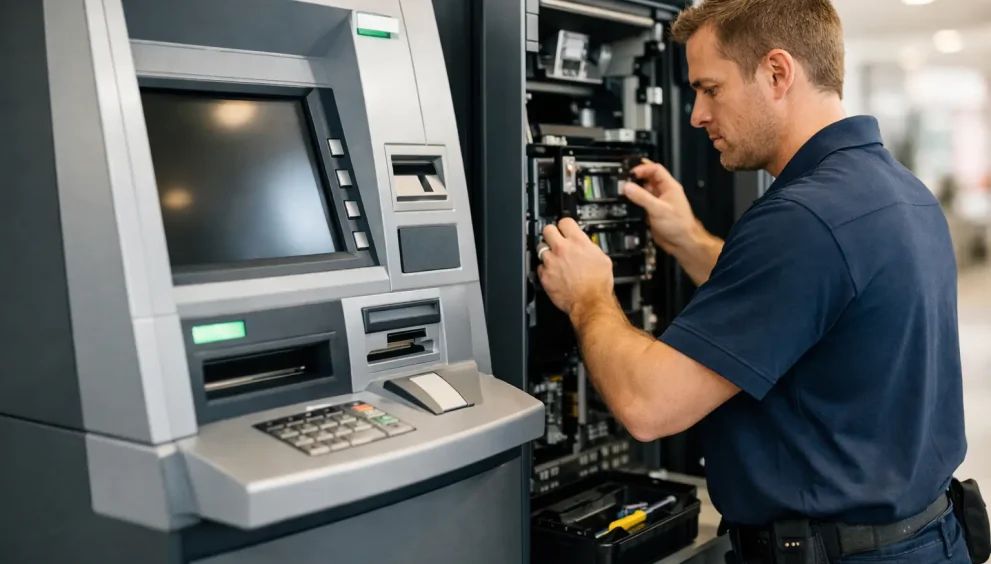
A deposit automation issue on one platform may require very different diagnostic and repair steps than a dispenser fault on another. Sending the nearest technician who lacks model-specific experience can increase site time, repeat visits, and parts consumption. In contrast, assigning based on failure type and skill often improves first-time fix performance even if travel time is slightly longer.
This is one of the more practical atm service management best practices because it forces organizations to treat technician competence as a schedulable asset. It also highlights where cross-training is missing. If too many incident classes depend on a narrow group of specialists, the service model may look efficient on paper while remaining fragile in the field.
Parts strategy is a service strategy
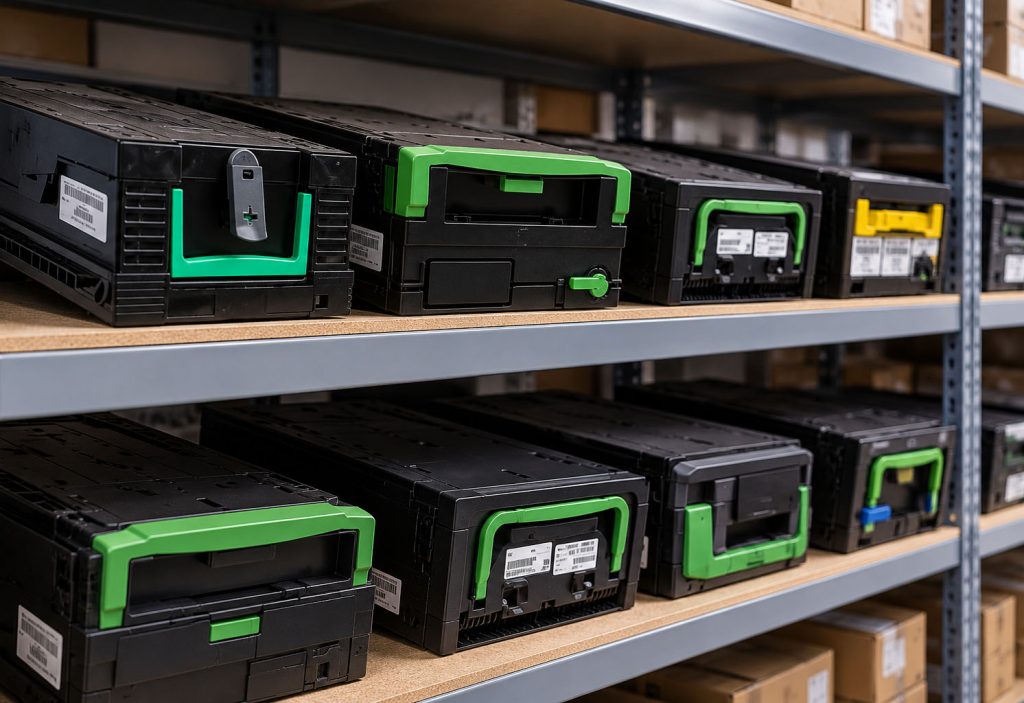
Parts planning is often discussed as a supply chain issue, but for ATM fleets it is a direct service management variable. If the right modules are not positioned near likely failures, dispatch performance suffers no matter how well the call center operates.
The trade-off is cost. Overstocking field inventories ties up capital and increases the risk of carrying parts for equipment nearing end of support. Understocking drives delays, repeat visits, and emergency logistics costs. The right balance depends on fleet age, hardware mix, failure history, and regional demand variability.
The more mature programs use failure data to set differentiated stocking rules. High-failure consumable assemblies and common replacement modules should not be managed the same way as low-frequency, high-cost components. They also review whether recurring failures point to a bad part population, environmental exposure at specific sites, or firmware and software interactions that parts replacement alone will not fix.
Preventive maintenance still matters, but it has to be selective
Preventive maintenance is easy to defend in theory and harder to optimize in practice. Blanket PM schedules across an entire fleet can consume technician capacity without materially improving availability, especially when platforms, usage profiles, and environmental conditions differ widely.
A better model is selective PM based on risk and usage. High-transaction terminals, outdoor units exposed to dust or temperature swings, and deposit-heavy devices may justify more frequent visits. Low-volume terminals in controlled environments may not. The objective is not to eliminate preventive maintenance but to move from calendar-based routines to evidence-based intervention.
This is also where software and hardware teams need tighter coordination. Some repeat mechanical faults are really the result of poor software state handling, delayed patching, or device driver issues. If service management treats those as purely field repair problems, the organization keeps paying for the same failure twice.
Vendor governance needs more than SLA compliance
Many ATM estates rely on a mix of OEM support, third-party maintainers, cash-in-transit providers, network partners, and internal operations teams. In that environment, service management can break down at the handoff points even when individual vendors meet their own contractual targets.
SLA attainment is not enough if responsibility is fragmented. A terminal can remain unavailable because one provider is waiting on another to confirm access, cash status, software readiness, or parts authorization. The bank or fleet operator still owns the customer outcome.
Effective governance means reviewing vendors against shared operational metrics, not isolated scorecards. Repeat incident rate, time to stable recovery, missed appointments, no-fault-found visits, and dependency-driven delays often reveal more than headline response times. It is also worth examining how escalation paths work after hours and on weekends, when many service gaps become visible.
Use root-cause discipline instead of accepting repeat failures
Repeat incidents are one of the clearest signs that service management is too reactive. When the same terminal, module, or site condition generates recurring calls, the issue is rarely just technician execution. More often, the organization lacks a disciplined process for root-cause review.
That review should include terminal model, software release, parts history, environmental conditions, carrier performance, and prior service actions. Sometimes the answer is obvious, such as a failing dispenser family or poor-quality replacement parts. In other cases, the pattern is operational: a site with access delays, unstable power, cash quality issues, or cleaning standards that are inconsistent across providers.
Without that level of review, organizations normalize repeat service as background noise. Over time, that raises cost and lowers confidence in the service model.
Standardize the workflow, not every local decision
Standardization is necessary, but there is a limit. National ATM programs often try to impose a single workflow for every terminal class, region, and service event. That can improve reporting consistency, yet it may also ignore local realities such as technician coverage density, branch coordination, or site access constraints.
The better balance is to standardize core data, ticket taxonomy, escalation rules, and closure criteria while allowing some local flexibility in scheduling and resource assignment. In other words, the organization should standardize what needs to be measured and governed, not pretend every market behaves the same.
That distinction matters in mixed fleets where branch ATMs, retail off-premise devices, and cash recyclers create different service demands. A rigid process can look disciplined while producing mediocre field results.
Service management should support modernization, not lag behind it
As fleets shift toward newer software architectures, more remote management, and expanded self-service functionality, service management has to adapt. Old assumptions about break-fix volume, dispatch timing, and technician task mix may no longer hold.
For example, better remote diagnostics can reduce unnecessary dispatches, but only if alert quality is high and triage teams trust the tools. More complex deposit and recycling functions can improve branch operations, but they also change failure modes and parts requirements. Migration periods are especially difficult because legacy and next-generation devices coexist, often under different support expectations.
The strongest ATM service organizations are usually not the ones with the fewest incidents. They are the ones that can see failure patterns early, assign resources intelligently, and recover service in a way that actually holds. In a market where uptime claims are easy to make and harder to validate, that operational discipline is what separates acceptable service from a dependable self-service channel.