


ATM Outsourcing Versus Ownership Compared

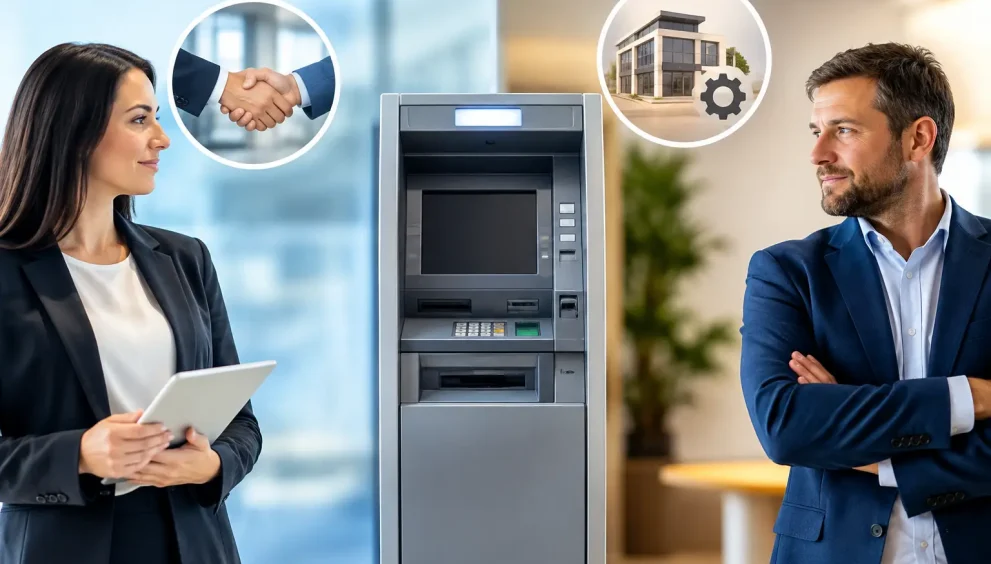
A failing cash dispenser at 7:30 a.m. is not a theoretical cost comparison. It is a dispatch decision, a customer-service event, a potential cash availability issue, and a test of whether the operating model works under pressure. ATM outsourcing versus ownership should therefore be evaluated as a question of operational accountability, not simply capital expense versus monthly service fees.
For financial institutions, retailers, and fintech operators, the right answer depends on fleet scale, geography, internal technical capability, cash-management arrangements, and the importance of direct control over the self-service channel. Neither model is inherently lower risk. Each shifts specific risks, costs, and responsibilities to a different part of the organization or supplier ecosystem.
What ATM ownership actually requires
Owning an ATM fleet gives an operator direct authority over equipment selection, configuration standards, service vendors, network relationships, branding, and lifecycle timing. That control can be valuable for institutions that treat the ATM as a core extension of branch, digital, and cash-access strategy.
The capital purchase is only the visible portion of ownership. Operators must also plan for installation, site preparation, communications, software licensing, certifications, monitoring, preventive maintenance, first-line support, second-line repairs, parts inventory, security upgrades, and eventual replacement. A low equipment purchase price can become expensive when a fleet includes multiple hardware generations, inconsistent image loads, or sites with poor access for technicians.
Ownership is often most practical when an institution has enough scale to standardize. A regional bank with several hundred similarly configured terminals may be able to negotiate service coverage, hold critical spares, manage software releases centrally, and use fleet data to direct maintenance spending. The same approach can be difficult for a small distributed fleet operating across several states, particularly when transaction volumes do not justify dedicated operations staff.
Control also creates responsibility. The owner must define service-level expectations, audit vendor performance, manage repeated-failure locations, and decide when repair is no longer economically sound. If the ATM remains unavailable because a part is backordered or a field technician lacks the required component, the operator still owns the customer outcome.
How ATM outsourcing changes the model
ATM outsourcing can cover a narrow service function or transfer most day-to-day responsibilities to a managed provider. Common arrangements range from outsourced monitoring and maintenance to full-service models that may include equipment placement, transaction processing coordination, cash services, branding support, and site management.
The principal attraction is predictable operating expense and access to specialized infrastructure. A provider with an established field network may have broader technician coverage, parts logistics, monitoring tools, and escalation processes than a smaller institution can maintain internally. Outsourcing can also reduce the administrative burden of coordinating multiple service companies across a geographically dispersed fleet.
That does not mean accountability disappears. It moves into the contract, governance process, and reporting structure. An operator needs clear definitions for availability, response time, restoration time, cash-out handling, parts exceptions, preventive maintenance, software patching, and dispute ownership. A contract that promises high uptime without specifying how uptime is measured can produce very different results from the service level management expects.
Outsourcing also requires careful attention to commercial incentives. A provider compensated primarily per transaction may prioritize placement and volume growth differently from an institution focused on customer access in lower-volume communities. A provider paid under a fixed monthly fee may have different incentives around dispatch frequency, preventive maintenance, and equipment replacement. The model should align financial incentives with the operator’s service objectives.
Cost comparisons need a full lifecycle view
The most common error in an ownership-versus-outsourcing evaluation is comparing a machine purchase price with a monthly managed-service quote. Those figures are not equivalent. A useful comparison starts with a five- to seven-year operating horizon and includes costs that are often assigned to different departments.
For ownership, the calculation should include acquisition, depreciation, implementation labor, communications, software and security updates, dispatches, parts, monitoring, insurance, vault and cash-management expenses where applicable, and end-of-life removal. It should also account for the internal time required to manage suppliers and investigate recurring incidents.
For outsourcing, operators should examine recurring fees, transaction-based charges, installation costs, early termination provisions, price escalators, excluded services, replacement obligations, and fees triggered by low transaction volume or out-of-scope field work. Cash-related economics require separate scrutiny. Cash replenishment, balancing, cash forecasting, loss responsibility, and settlement timing can materially change the total cost of an outsourced arrangement.
A managed monthly price may be higher than the modeled cost of self-operation for a stable, high-volume fleet. But it can still be justified if it reduces volatility, improves coverage in remote markets, or allows internal teams to focus on payments, branches, fraud controls, and other priorities. Conversely, ownership may create lower long-term cost but only if the organization has the discipline to manage standardization and lifecycle replacement.
Availability is a governance issue, not just a service metric
ATM uptime is affected by more than technician response. Communications failures, cash availability, host connectivity, application errors, card-reader faults, environmental conditions, and site access can all take a terminal out of service. An outsourcing agreement should identify which party owns each failure category and how the incident moves across organizational boundaries.
For example, a managed provider may be accountable for hardware maintenance but depend on the bank, processor, telecommunications carrier, armored carrier, or site landlord to resolve the underlying issue. Without a shared escalation model, the terminal can remain down while each party reports that its own component is operating normally.
Ownership creates the same coordination challenge, but the institution has direct authority to set priorities across its vendors. Outsourcing can improve response consistency when the provider has mature orchestration capabilities, yet the operator still needs visibility into ticket aging, repeat incidents, out-of-service causes, and locations that consistently miss service targets.
The best reporting separates availability from availability quality. A terminal that returns to service after a temporary reset but fails again the next day is technically available for part of the measurement period, but it is not operationally reliable. Repeat-call rates, mean time to restore, cash-out duration, and first-time fix rate usually provide a more useful picture than a single uptime percentage.
Security, compliance, and data responsibilities remain with the operator
Outsourcing can assign operational tasks, but it does not eliminate the need for oversight of security controls. Financial institutions remain accountable for third-party risk management, PCI-related responsibilities, physical security expectations, software currency, access management, and incident response arrangements.
Contracts should address who controls cryptographic key activities, who can access terminal logs, how remote-access sessions are approved and recorded, and how software images are maintained. Operators should also understand the process for applying security patches when a terminal runs a specialized application or has local configuration requirements.
Data access deserves equal attention. Managed providers may generate valuable information on transaction performance, alarms, cash events, device health, and technician activity. The operator should establish rights to that data, the format in which it can be exported, retention periods, and the process for retrieving it at contract termination. A provider dashboard is useful, but it should not become the only place where critical fleet history exists.
When a hybrid model makes more sense
The choice is not always binary. Many operators retain ownership of equipment and customer experience while outsourcing monitoring, field maintenance, cash logistics, or selected technology functions. Others use a managed model for remote or low-density markets and retain direct control over high-volume branch and flagship locations.
A hybrid approach can reduce operational burden without giving up strategic flexibility. It does, however, increase the need for clear interface management. If one company monitors alarms, another manages cash, and a third provides break-fix support, responsibility maps and escalation rules need to be explicit before an outage occurs.
This model is particularly relevant during fleet modernization. An institution may own legacy terminals that remain serviceable while using a managed deployment model for new locations or temporary expansion. That approach can limit capital exposure, but only if hardware, software, security, and reporting standards remain consistent across both populations.
The decision should start with operating facts
Before selecting a model, decision-makers should establish a baseline: fleet age and configuration diversity, transaction volume by location, current availability, dispatch history, recurring failure types, cash-out frequency, internal support capacity, and the full cost of vendor management. These facts reveal whether the central problem is capital pressure, poor service coverage, weak standardization, aging equipment, or insufficient operational visibility.
The most effective choice is the one that gives the operator credible control over service outcomes at an acceptable lifecycle cost. For some fleets, that means building disciplined ownership capabilities. For others, it means using a managed provider with measurable obligations and active governance. The decisive question is not who owns the terminal, but who can keep it secure, available, funded, and supportable when the field conditions are least convenient.