


ATM Accessibility Compliance Guide for Fleet Teams

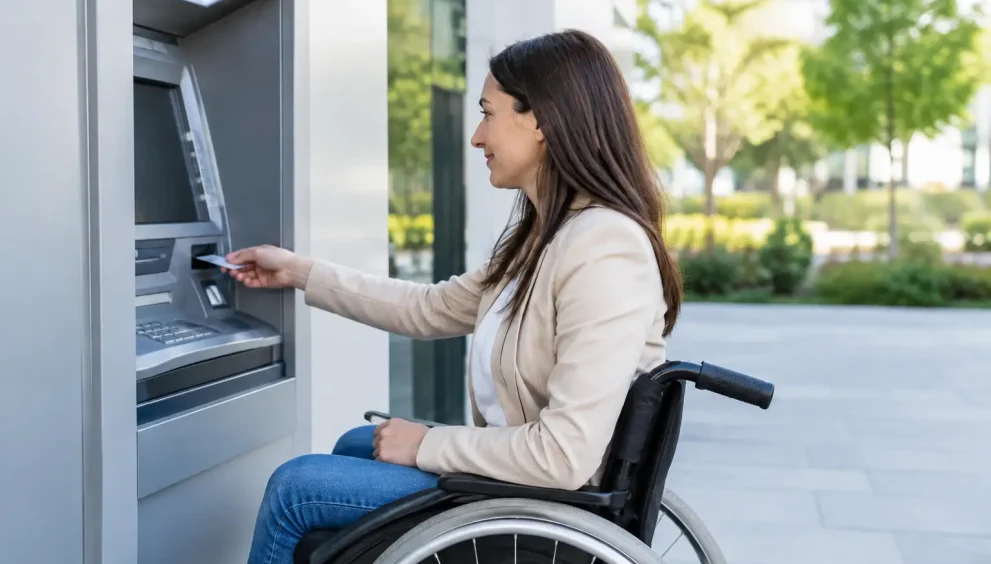
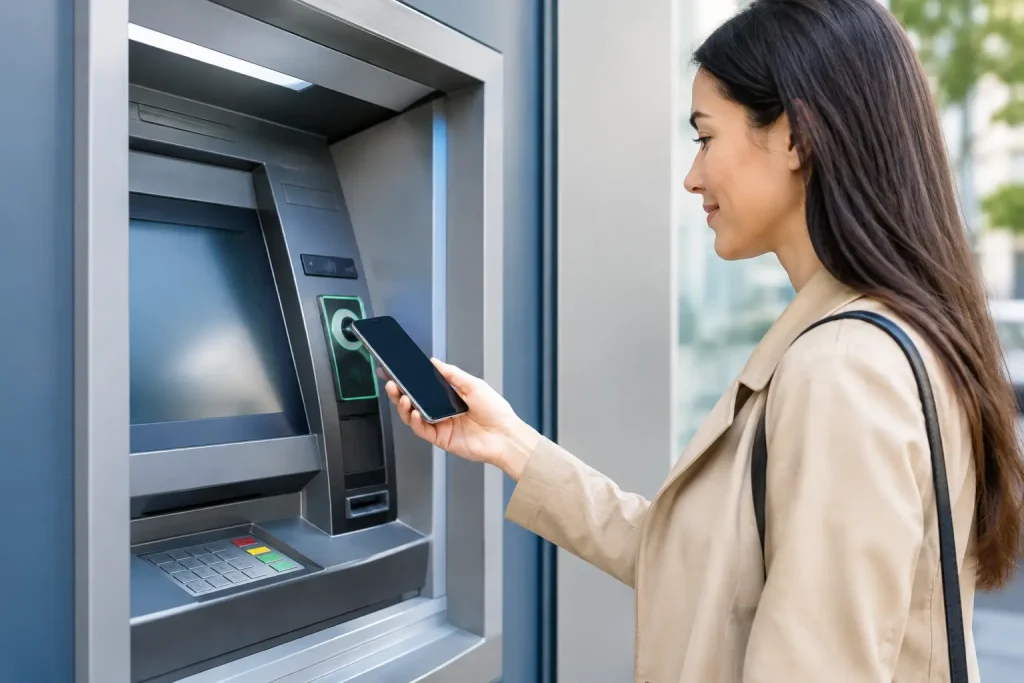
A working ATM accessibility compliance guide has to address more than a machine’s accessibility feature set. A compliant deployment depends on the terminal, the software image, the physical site, and the way the fleet is maintained after installation. A speech-enabled ATM can still create exposure if a wheelchair user cannot reach it, find the accessible route, use the controls, or complete a transaction with reasonable privacy.
For U.S. financial institutions, deployers, and service organizations, the practical challenge is converting broad accessibility obligations into repeatable field standards. That means knowing which requirements apply, identifying gaps across a mixed fleet, and ensuring that service events do not quietly undo compliance work.
Start with the regulatory baseline
The Americans with Disabilities Act is the primary federal framework for public-facing ATMs. The 2010 ADA Standards for Accessible Design establish technical and scoping requirements for ATM access, including speech output, tactilely discernible controls, privacy, reach ranges, and accessible approaches to the equipment. Depending on the institution, Section 504 of the Rehabilitation Act, state accessibility laws, local building codes, lease provisions, and contractual requirements may add further obligations.
The legal analysis is not always identical across locations. A retail ATM in a convenience store, a drive-up unit at a bank branch, an ATM in a transit facility, and a terminal inside a secured campus can present different questions about access, alterations, and responsibility. The safest operational assumption is not that a standard hardware configuration resolves every issue. Compliance should be assessed at the installed location.
This is also an area where internal operations teams should work with qualified compliance and legal personnel. Fleet teams can document conditions and correct known defects, but they should not make unsupported determinations about exemptions or whether an alteration triggers a particular construction requirement.
Accessibility is a system condition
Accessibility failures often emerge at the boundaries between teams. Equipment engineering may validate the terminal model. Site planning may approve the location. A field technician may complete installation. Yet no one may own the final question: can a person with a disability independently use this specific ATM today?
A useful inspection model covers four connected layers:
- Terminal interface: speech output, headphone jack, tactile keypad cues, screen readability, input controls, transaction flow, and accessible error handling.
- Physical access: route from public arrival point, changes in level, clear floor space, reach range, protruding objects, and obstructions around the machine.
- Site environment: lighting, signage, door hardware, vestibules, parking and curb conditions, and safe access during normal operating hours.
- Operational state: out-of-service status, software configuration, damaged accessibility components, blocked approaches, and whether repairs restore the unit to its approved condition.
The fourth layer is frequently underestimated. A terminal that met requirements at commissioning can become noncompliant when a headphone jack is damaged, a cabinet is moved during remodeling, a queue barrier reduces clear space, or a software upgrade changes the speech experience.
Verify the terminal configuration before the site visit
Most current ATM platforms offer accessibility capabilities, but fleets are rarely uniform. Older terminals, acquired portfolios, refurbished units, and machines operating on long-lived software baselines deserve special attention. Hardware capability does not prove that the deployed configuration is correct.
Speech output should provide the information and prompts necessary to conduct a transaction privately through a standard headphone connection. Teams should test the actual transaction path, not merely confirm that audio starts. The test should cover card entry, PIN entry, account selection, withdrawal amount selection, warnings, errors, receipt preferences, transaction completion, and any accessibility-specific menus. Audio volume control and a clear method for initiating the accessible mode are also field-level concerns.
Controls must be usable without relying on vision. Tactile indicators, especially the raised dot on the number five key, are familiar requirements, but technicians should also look for worn keypads, missing labels, damaged function keys, and overlays that interfere with tactile use. Capacitive touch interfaces and soft-key designs require closer review because accessibility can depend heavily on software behavior and supplemental controls.
Privacy is another configuration and placement issue. Speech output must not expose private customer information to bystanders. This can require headphones, sensible audio design, appropriate screen shielding where applicable, and attention to the physical environment. A noisy lobby or poorly positioned terminal can make an otherwise functional accessibility feature difficult to use.
Audit the installed site, not the floor plan
Floor plans and site surveys are useful, but the final installed condition controls the customer experience. Field teams should assess the route from the public entrance or other arrival point to the ATM. Temporary displays, merchandise racks, floor mats, snow removal equipment, furniture, and cash-in-transit materials can turn a compliant route into an inaccessible one.
Clear floor space in front of the ATM requires special attention. The issue is not simply whether there is open area nearby. The space must permit a wheelchair user to position at the terminal and use the controls. Counter extensions, bollards, planter boxes, waste bins, and promotional stands are common sources of interference. In vestibules, the door swing and the position of adjacent equipment can further constrain access.
Reach-range problems are equally common, particularly when a terminal is installed behind a counter edge, on a raised base, or next to protective fixtures. The screen, card reader, cash dispenser, receipt printer, keypad, and accessibility controls must be evaluated as a working set. A customer should not need to stretch around a bollard to retrieve cash or a receipt.
Drive-up ATMs require a distinct review. Vehicle reach, parallel approach, accessible alternatives, lane geometry, and site circulation all matter. A drive-up terminal should not be treated as a substitute for an accessible walk-up ATM without confirming the applicable requirements and the actual access available to customers.
Build a repeatable fleet audit process
A compliance program becomes manageable when the organization stops treating inspections as one-off projects. Start by building an asset-level inventory that connects each terminal to its precise site location, model, software version, accessibility configuration, installation date, and responsible business owner. This record should distinguish between manufacturer capability and verified field condition.
Then use a standardized inspection form that combines measurements, functional tests, photos, findings, severity, and remediation ownership. Photos are valuable because conditions change and descriptions such as “area appears clear” are difficult to validate later. Where measurements are required, use calibrated tools and make the measurement method consistent across vendors and regions.
Risk-based prioritization is appropriate, but it should be disciplined. High-traffic branch and retail locations, terminals with known physical constraints, older equipment, recently remodeled sites, and locations that have generated complaints should move to the front of the review queue. A low-volume site may still warrant prompt action if the defect prevents access altogether.
Remediation should separate quick operational corrections from capital work. Removing an obstruction, replacing a damaged headphone jack, correcting a software setting, or retraining site personnel may be resolved quickly. Reworking a vestibule, relocating an ATM, modifying a foundation, or replacing an obsolete terminal may require landlord coordination, permits, budgeting, and a longer timeline. Both types of work need tracked due dates and accountable owners.
Include accessibility in change management
Many compliance problems are created after the original deployment. Software releases can alter menu order, audio prompts, timeout behavior, and screen-reader logic. Hardware refreshes can change cabinet dimensions, component locations, or peripheral interfaces. Branch modernization projects can affect routes, clearance, lighting, and vestibule access.
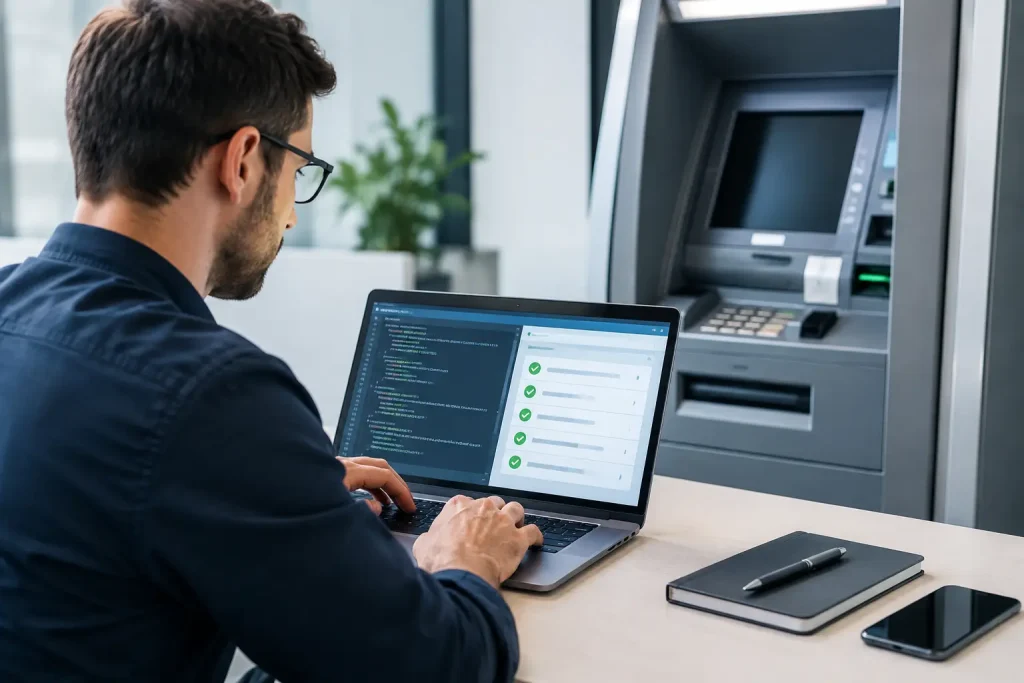
Accessibility checks should therefore be embedded in project gates. Before a new model enters the approved hardware catalog, validate its accessible functions under the intended software build. Before an install or relocation is accepted, require a site-level accessibility signoff. Before a significant software release is broadly deployed, include functional testing with headphones and nonvisual navigation in user acceptance testing.
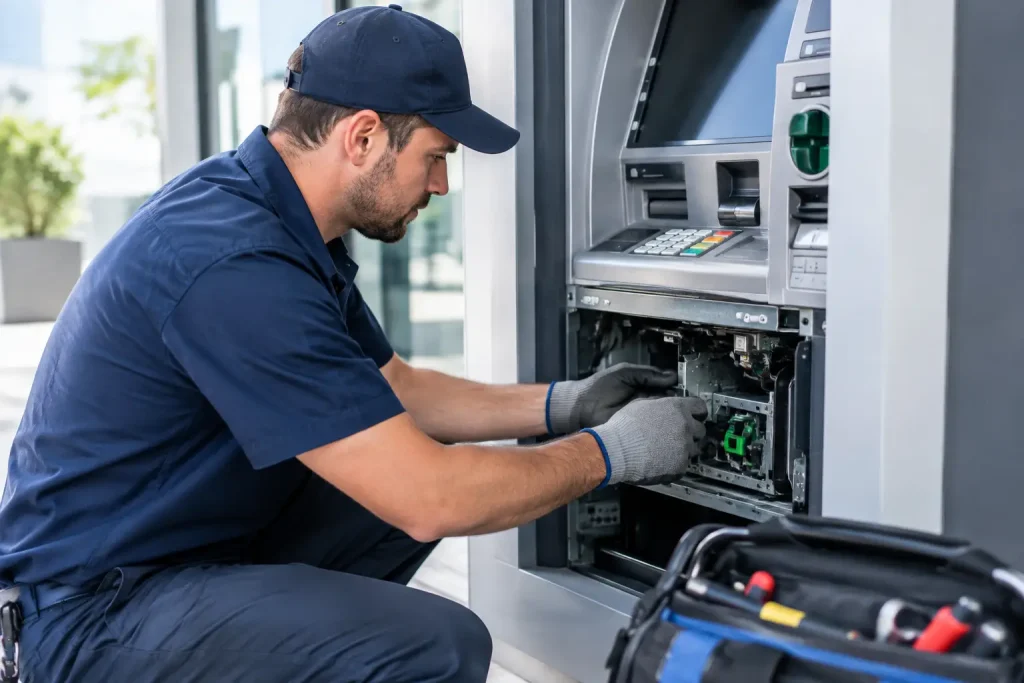
Service providers also need clear escalation rules. A technician who finds a blocked accessible route may not control the site, but the finding should enter a documented workflow rather than disappear in a service note. Likewise, a failed audio test or damaged tactile keypad should be categorized as more than a cosmetic defect when it prevents independent use.
Documentation is part of the control environment
Good records do not make an inaccessible ATM accessible, but poor records make fleet governance harder and remediation slower. Maintain inspection results, work orders, photographs, test evidence, component replacements, software-release approvals, and closure verification. For leased or third-party locations, document which party is responsible for physical access, building modifications, and terminal maintenance.
Documentation also helps distinguish recurring design issues from isolated defects. If multiple sites show the same clearance failure after a rollout, the problem may sit with the deployment standard or site-selection criteria rather than local execution. That is the point at which engineering, real estate, procurement, and operations need to act together.
The practical objective is straightforward: every customer-facing ATM should remain independently usable throughout its service life, not just on installation day. Treat accessibility as a measurable operating condition, and fleet teams will be better positioned to identify failures early, direct capital where it is needed, and maintain service access as the network changes.