




ATM Remote Monitoring Guide for Operators

A terminal goes offline at 2:14 a.m. If the first notice comes from a customer complaint at 8:05, the problem is no longer technical alone. It has already become an uptime, cash access, and service dispatch issue. That is why an atm remote monitoring guide matters for ATM operators, service providers, and banking technology teams managing distributed fleets.
Remote monitoring is often described as a visibility tool, but that understates its role. In practice, it sits at the center of ATM operations, connecting terminal health, network performance, cash status, security events, and service workflows. The quality of that monitoring directly affects truck rolls, mean time to repair, first-time fix rates, and how quickly teams can separate a minor communications issue from a device-level failure.
What ATM remote monitoring is really for
At a basic level, remote monitoring collects status information from an ATM and presents it to an operations team. The more useful definition is broader. A mature monitoring environment helps operators answer three practical questions: Is the terminal available, is it functioning correctly, and does the event require action now or later?
That distinction matters because ATM fleets generate noise. A communication timeout, a dispenser warning, a receipt printer near-end message, and an out-of-cash alert do not carry the same operational urgency. If the platform treats every event as equivalent, service desks become alert clearinghouses instead of control points.
The strongest monitoring programs are built around triage, not just data collection. They prioritize event classification, escalation logic, and correlation across subsystems. A terminal that briefly drops from the network may not need a technician. A terminal showing repeated dispense retries, cassette issues, and low cash at the same site probably does.
The core layers in an ATM remote monitoring guide
Any practical ATM remote monitoring guide should separate the stack into layers. That makes it easier to evaluate tools, assign ownership, and identify blind spots.
Terminal and device health
This is the most familiar layer. It includes dispenser status, card reader condition, printer states, encrypting PIN pad health, sensor activity, journal signals, and software process status. For service organizations, this is where remote monitoring starts to influence maintenance efficiency.
Not every device event has equal diagnostic value. A hard fault is straightforward. Intermittent warnings are harder because they may point to environmental issues, worn components, unstable power, or operator handling patterns. Monitoring systems need enough granularity to show trends, not just snapshots.
Network and communications status
Many apparent ATM failures are really connectivity failures. The distinction is crucial because sending a field technician to a functioning ATM with a WAN issue wastes time and budget. Monitoring should track link availability, transaction path failures, latency patterns, router status where applicable, and communications recovery behavior.
For fleets using multiple carriers or mixed communication methods, network monitoring also becomes a resilience tool. It can reveal whether a site problem is isolated, regional, or tied to a provider outage. That changes escalation paths quickly.
Cash and deposit visibility
Cash status monitoring is not just about out-of-cash prevention. It helps balance cash utilization, replenishment timing, and service economics. If a terminal repeatedly runs one denomination low while another cassette remains underused, the issue may be forecasting rather than demand.
Deposit automation adds another layer. Capacity thresholds, jam conditions, reject rates, and unavailable deposit functions all affect customer experience and branch operations. Monitoring needs to distinguish between degraded service and full outage, especially in mixed-function self-service environments.
Security and environmental events
ATM remote monitoring increasingly overlaps with security operations. Cabinet access, vibration, temperature, power anomalies, and suspicious reboot patterns can all be operational signals as well as security indicators. The challenge is avoiding overlap without ownership.
In many organizations, physical security, fraud prevention, network operations, and ATM service management use different systems and workflows. The better model is coordinated visibility with role-based response, rather than forcing one team to absorb every event.
What to monitor first if the program is immature
Teams modernizing an older fleet or consolidating multiple monitoring platforms should resist the temptation to instrument everything at once. Broad visibility sounds attractive, but immature programs usually fail because event quality is poor and workflows are undefined.
Start with terminal availability, dispenser status, receipt printer status, cash thresholds, communications state, and critical security alarms. Those categories cover most of the operational events that drive customer impact and field dispatch decisions. Once teams trust the event model, they can add more granular diagnostics and predictive indicators.
This is one of the main trade-offs in any atm remote monitoring guide. More telemetry is not automatically better. If the service desk cannot interpret it, the value is theoretical.
Alerting logic matters more than dashboard design
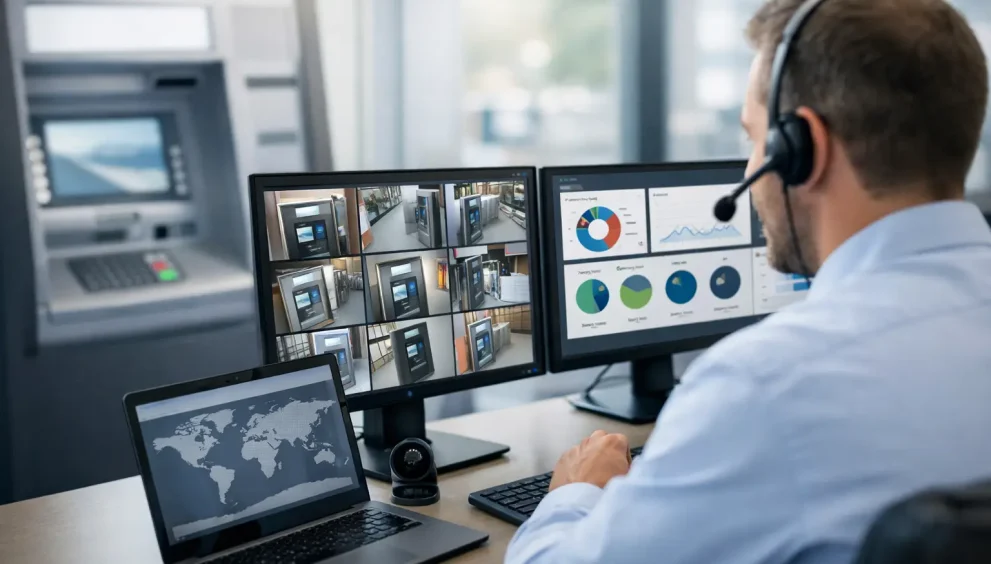
Many monitoring platforms present well on a dashboard. That is useful for oversight, but operational gains usually come from alert logic, ticketing integration, and escalation design. A clean screen does not reduce downtime on its own.
Teams should focus on how alerts are generated, suppressed, grouped, and routed. A terminal that produces ten related events in two minutes should not create ten separate dispatch decisions. Correlation rules should collapse symptom clusters into a probable cause view where possible.
Timing also matters. Immediate alerts make sense for hard down terminals, security events, and cash outages at high-volume sites. But some low-severity conditions are better handled through threshold-based review. Otherwise, overnight teams spend hours acknowledging events that would clear on their own.
Integration with service operations
Remote monitoring has limited value if it ends at observation. For most operators, the real test is whether monitoring shortens diagnosis and improves dispatch quality.
That means integration with ticketing, remote management tools, field service platforms, and sometimes parts inventory systems. When an event moves from alert to work order, the technician should receive more than a site address and a generic device fault. Useful context includes recent event history, recurring faults, device model, software version, prior service actions, and whether the issue appears to be communications, hardware, or cash-related.
This is where institutions often see the gap between buying a monitoring platform and operating a monitoring program. The software may be capable, but if event taxonomies are inconsistent across OEMs, processors, and managed service providers, the workflow still breaks down.
Common failure points in remote monitoring deployments
The first is alert fatigue. When teams receive too many low-value notifications, serious events lose urgency. The second is inconsistent event normalization across a mixed fleet. Different ATM models and software stacks may describe the same functional issue in different ways, which complicates reporting and triage.
The third is overreliance on polling without enough state awareness. Polling confirms whether a terminal responds, but it may miss the difference between fully available, partially degraded, and transactionally impaired. That gap matters when a terminal is technically online but unable to dispense cash.
Another common issue is unclear ownership. If communications events go to one team, device faults to another, and cash events to a third, incident resolution slows unless handoffs are tightly defined. Monitoring should clarify accountability, not expose organizational silos.
Using remote monitoring to support modernization
As ATM estates shift toward newer software architectures, API-driven management tools, and more connected self-service devices, remote monitoring becomes more strategic. It is no longer just a maintenance function. It informs availability planning, fleet standardization, vendor comparison, and service model design.
For example, a bank evaluating ATM refresh cycles can use monitoring data to compare failure patterns across hardware generations. A managed service provider can use the same data to identify repeat dispatches tied to specific components or locations. A fintech operating a targeted ATM footprint may focus more on uptime by geography, carrier dependency, and transaction concentration than on broad fleet averages.
The right monitoring model depends on fleet size, outsourcing structure, and technical diversity. A bank with a highly standardized estate can push further into automation. A mixed fleet with legacy software and multiple service vendors may need a more conservative approach built around event cleanup and governance first.
How to judge whether monitoring is working
The easiest mistake is measuring platform usage instead of operational effect. A successful program should reduce avoidable dispatches, improve repair times, increase terminal availability, and shorten the gap between event occurrence and response.
It should also improve decision quality. If teams can identify chronic sites, unstable communications paths, recurring hardware faults, or poor cash forecasting earlier, monitoring is doing more than watching. It is helping shape the operating model.
That requires regular review. Event rules that made sense six months ago may no longer fit a changed fleet, a new carrier mix, or updated cash strategies. Monitoring is not a set-and-forget discipline. The environment changes, and the logic has to change with it.
The most useful closing thought is a practical one: remote monitoring works best when it is treated as an operations system, not a reporting feature. When alerts are trusted, ownership is clear, and data feeds action, the ATM is no longer a black box at the edge of the network. It becomes a manageable endpoint with fewer surprises.