



ATM Outsourcing vs In-House: What Fits Best?

A fleet that misses first-time fix targets by a few points can erase the savings that looked compelling on paper. That is why the ATM outsourcing vs in-house decision rarely comes down to labor rates alone. For banks, independent deployers, and managed service providers, the real issue is how service ownership affects uptime, cash access, compliance exposure, vendor coordination, and the ability to adapt as fleets age or modernize.
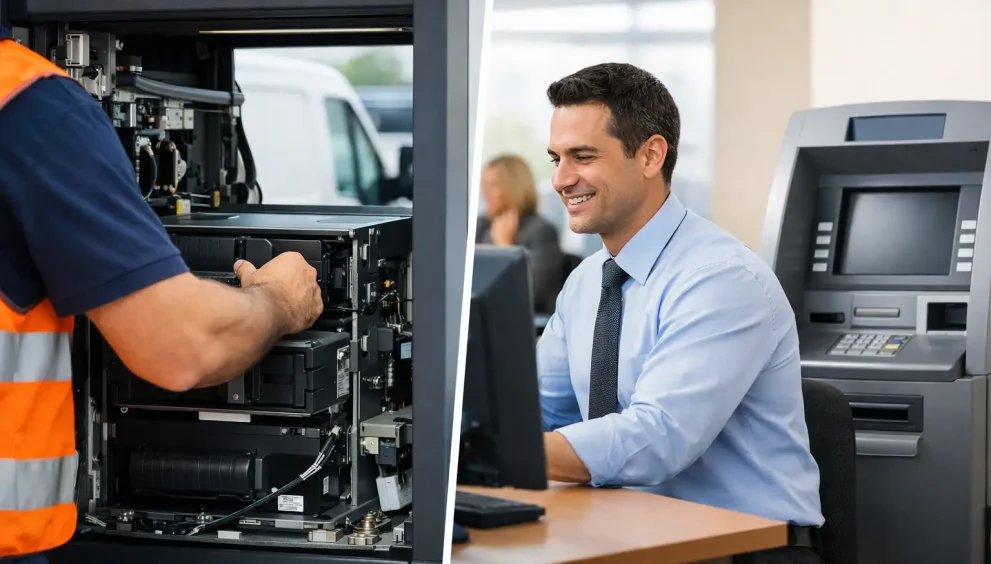
This is not a binary choice in every case. Many ATM operators run hybrid models, keeping strategic functions close while contracting field coverage, cash services, monitoring, or depot activity to outside partners. The better question is not which model is universally better, but which operating model fits the fleet, geography, service expectations, and internal capabilities of a given organization.
ATM outsourcing vs in-house starts with operating reality
A small regional fleet with concentrated geography behaves differently from a nationally dispersed estate with multiple hardware generations and several communications environments. The same is true for a bank with a mature internal service organization versus one that has strong channel ownership but limited field engineering depth.
In-house service gives institutions direct control over dispatch logic, technician standards, change windows, and escalation paths. That can be valuable when ATM availability is tied closely to brand perception, branch operations, or local market commitments. It also supports tighter integration between self-service operations, IT, security, and cash management teams.
Outsourcing shifts some of that operational burden to a specialist provider. In the best cases, that brings denser field coverage, broader parts logistics, established service workflows, and access to expertise that may be difficult to build internally. But outsourcing does not remove accountability. It changes where execution sits and increases the importance of service governance, contract design, and performance measurement.
Cost is only one part of ATM outsourcing vs in-house
Cost is often the starting point, but it is one of the easiest areas to misread. Internal models carry visible expenses such as payroll, training, fleet vehicles, tools, depot inventory, and management overhead. They also carry less visible costs, including coverage gaps during turnover, the burden of supporting legacy hardware, and the investment required to maintain current technical skills as software, security controls, and peripheral devices evolve.
Outsourcing can convert some fixed cost into variable or contractual cost. That may appeal to operators looking for budget predictability or relief from workforce management. Yet outsourced pricing can become less attractive when service scopes are poorly defined, call volumes fluctuate unexpectedly, or exceptions generate additional charges. If project work, software support, security remediation, and after-hours coverage are not clearly addressed, the contract price may understate the true operating cost.
A useful comparison looks beyond annual spend. It should examine cost per terminal, cost per incident, repeat visit rates, parts consumption, SLA attainment, and the operational cost of downtime. A lower service price does not help much if terminals remain out of service longer or if issue ownership becomes fragmented.
Where in-house often has an edge
In-house models tend to perform well when fleets are geographically concentrated, terminal standards are relatively consistent, and the organization already has a technical field culture. They can also make sense where ATM service is operationally linked to branch support, security response, or internal network teams.
There is another advantage that rarely appears in high-level comparisons: institutional memory. Internal teams usually understand site history, recurring failure patterns, local environmental factors, and the informal workarounds that keep older terminals stable until replacement cycles catch up.
Where outsourcing often has an edge
Outsourced models often perform better when coverage needs are broad, service demand is uneven, or the fleet includes multiple markets where hiring and retaining technicians is difficult. A specialized provider may also deliver stronger depot operations, deeper bench strength for hardware variants, and faster access to regional field resources during spikes in incident volume.
This can be especially relevant during platform migrations, EMV-related updates, communications changes, operating system transitions, or security retrofit programs, when demand for qualified labor rises quickly.
Control, accountability, and escalation paths
Control is one of the main arguments for in-house service, but control only matters if the organization has the systems and leadership discipline to use it effectively. Internal ownership can speed decisions, reduce handoffs, and simplify escalation. If a software image fails, a communications issue sits between teams, or a recurring hardware fault needs engineering attention, internal coordination is often faster.
Outsourcing introduces another layer between the terminal owner and the technician touching the machine. That does not automatically mean slower response or weaker outcomes. Mature service partners can be highly disciplined operators. The difference is that accountability must be formalized. Service level agreements, parts ownership rules, ticket routing, root cause reporting, and governance meetings become central to performance.
Problems usually appear at the boundaries. A cash issue may involve the service provider, armored carrier, ATM software vendor, host, and bank operations team. If those boundaries are not clearly managed, outsourced environments can produce finger-pointing rather than resolution. Internal models can suffer from the same issue, but the organization has fewer contractual seams to manage.
Security and compliance are not neutral factors
Physical service, software maintenance, key management practices, access control, and patch execution all influence risk. In-house teams may align more tightly with internal security policies and audit structures, particularly in institutions with mature governance. But that assumes those teams are consistently trained, documented, and monitored.
An outsourcing partner may bring standardized procedures and a broader compliance discipline across many clients. That can be beneficial, especially for operators that do not have deep internal ATM governance. Still, outsourced security performance depends heavily on vendor oversight. Who validates background checks, technician credentialing, software handling practices, and exception reporting? Who confirms that field procedures match contractual language and audit expectations?
For many operators, the decision is less about whether one model is safer and more about whether the control environment is actually enforceable in practice.
Service quality depends on fleet complexity
Not all ATM fleets are equally difficult to support. A standardized fleet on a narrow hardware base is far easier to maintain than a mixed estate with multiple OEMs, aging dispensers, different image versions, and scattered communications upgrades. That complexity changes the outsourcing calculation.
In-house teams can become highly effective in complex environments if they have time, documentation, and parts support. But complexity also drives training burden and raises the risk that knowledge is concentrated in a few experienced individuals. When those people leave, service consistency can drop quickly.
Outsourcing can reduce that dependency if the provider has sufficient multi-vendor depth. It can also worsen it if the provider relies on broad coverage technicians without enough model-specific expertise. The right question is not whether a vendor can service ATMs in general, but whether it can support this fleet, with these failure modes, under these uptime expectations.
The hybrid model is often the practical answer
Many operators end up between the two poles. They keep strategy, monitoring, vendor management, software control, and performance analytics in-house, while outsourcing dispatch, field maintenance, cash replenishment coordination, or depot repair. Others use internal teams for urban core markets and outsourced coverage for rural or low-density regions where staffing is less efficient.
Hybrid models work best when responsibilities are explicit. Ambiguity creates duplicated effort in some areas and no ownership in others. If an organization keeps command-and-control functions internally, it needs the tools and staffing to manage those responsibilities well. If it outsources execution, it still needs meaningful visibility into incident trends, first-time fix rates, SLA exceptions, and recurring site issues.
How to evaluate the decision
A useful review starts with current-state data, not assumptions. Incident volume, mean time to repair, repeat visits, cash-out frequency, technician travel patterns, terminal age, and site criticality all matter. So does the pace of upcoming change. A stable fleet nearing replacement may justify a different model than one entering a major refresh cycle.
It also helps to test each model against failure scenarios rather than average conditions. How does the organization handle a regional communications outage, an urgent software remediation, a surge in dispenser failures, or a sudden labor shortfall? These moments reveal whether a service model is resilient or merely efficient during normal weeks.
Leaders should also be honest about internal appetite for operational ownership. Running ATM service in-house is not just a staffing question. It requires process discipline, field management, inventory control, technical training, quality assurance, and a willingness to measure performance continuously. If that commitment is missing, direct control may be more theoretical than real.
The best choice is usually the one that matches service design to business reality rather than ideology. Some fleets benefit from the tighter control and institutional knowledge of internal teams. Others gain more from outsourced scale, geographic reach, and established service infrastructure. The organizations that perform best tend to treat the model as an operating decision, not a procurement exercise, and adjust it as the fleet and service environment change.