





ATM Incident Response Checklist That Works

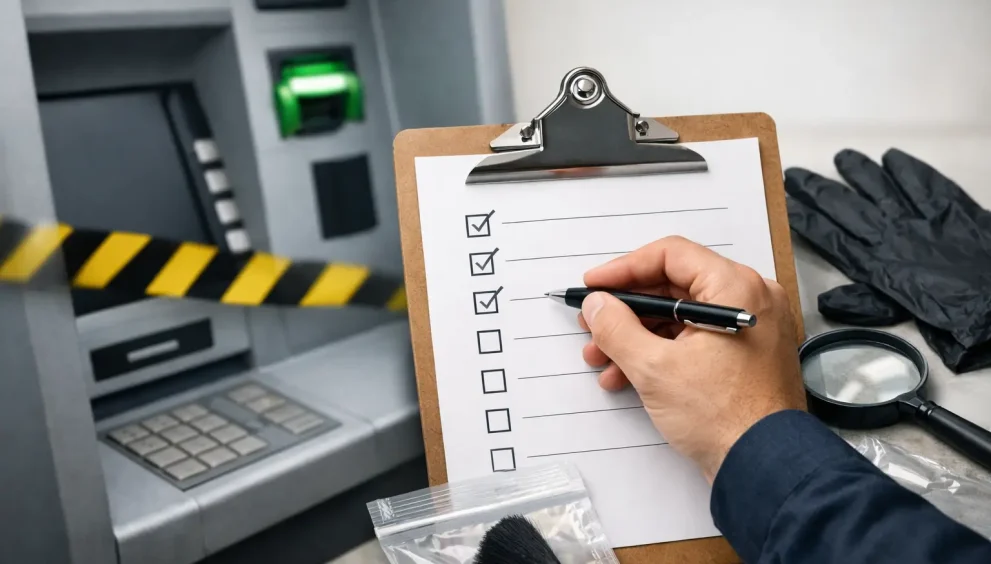
A card capture, cash dispense error, malware alert, skimmer report, or communication outage can turn into a larger ATM operations problem within minutes. That is why an ATM incident response checklist needs to do more than assign tasks. It has to support fast triage, protect evidence, limit customer impact, and keep the terminal, network, and service chain aligned under pressure.
For most operators, the weak point is not whether a checklist exists. It is whether that checklist reflects the actual mix of hardware, software, cash processes, acquirer requirements, and field support models in use across the fleet. A strong incident process is operational, not theoretical. It assumes that incidents do not arrive cleanly labeled and that the first report from the field is often incomplete.
What an ATM incident response checklist should actually cover
An effective ATM incident response checklist starts with classification. A terminal that is hard down after a storm event, one that is suspected of jackpotting, and one with repeated dispense disputes may all generate urgent tickets, but they do not require the same first actions. Teams need a shared way to distinguish service interruption from fraud risk, cyber compromise, physical attack, cash loss exposure, and customer-impact incidents.
That classification drives the next decision – whether the priority is containment, continuity, or investigation. In some cases, keeping the machine online for customer access may be appropriate while diagnostics continue. In others, especially where malware, black box attack indicators, or skimming devices are suspected, taking the terminal out of service quickly is the safer move. The trade-off is obvious: every minute of availability matters, but so does preventing a contained event from becoming a loss event.
A practical checklist also needs to identify ownership early. ATM incidents often cross organizational boundaries fast. The first alert may come from a bank help desk, a managed services provider, a field technician, a monitoring platform, law enforcement, or a merchant location. If escalation paths are vague, time is lost deciding who is authorized to disable the terminal, dispatch service, notify the processor, or contact the cash provider.
The first 15 minutes of ATM incident response
The first stage of any ATM incident response checklist should be designed for speed and consistency. At this point, teams are not trying to solve the entire incident. They are trying to answer a short set of operational questions.
What exactly is being reported, and by whom? Is the terminal still transacting? Is there a potential cash loss, customer data exposure, or active fraud event? Has the issue been observed at one device, one location, or across multiple endpoints? Are there signs of physical tampering, unusual cabinet access, unexplained reboots, or communication anomalies?
Those early checks matter because incident type can be misread. A basic communications failure may initially resemble terminal compromise. A software fault may be confused with suspicious behavior. The checklist should force teams to verify recent software updates, remote management activity, maintenance visits, power events, and known network issues before assumptions harden into the wrong response path.
If the event appears credible and active, containment should happen before deeper troubleshooting. That may mean placing the terminal out of service, disabling transactions through the host, restricting remote access, blocking card acceptance, or isolating the site from the network depending on the threat scenario. The exact sequence depends on architecture. Older estates with mixed vendors and inconsistent remote control capabilities may require a different playbook than a modern fleet with centralized management.
Preserve evidence before the cleanup starts
One of the most common response failures is accidental evidence destruction. A well-meaning technician reboots the unit, clears a fault, removes a suspicious device, or restarts middleware before logs, images, surveillance references, and event histories are secured. That can compromise forensic review and make it harder to determine whether the issue was fraud, malfunction, or process failure.
The checklist should require immediate preservation of terminal logs, switch and host logs, EJ data, remote monitoring alerts, software status, and timestamps. It should also capture who accessed the terminal remotely or physically and when. If there is suspected tampering, teams need a clear rule on whether a field technician can touch the machine before security, fraud, or law enforcement guidance is received. That answer will vary by operator, but the decision should be made in advance, not in the middle of the event.
Cash risk, customer impact, and service continuity
Not every ATM incident is primarily a security problem. Some are operations problems with direct customer and balancing consequences. A dispense fault, deposit jam, suspected partial dispense, card retention spike, or cassette issue may not trigger a formal cyber response, but it can still create financial exposure and customer dissatisfaction.
An ATM incident response checklist should therefore include a parallel track for cash and customer handling. Teams need to know whether cassettes should be locked down, whether balancing must be expedited, whether disputed transactions require temporary holds or review, and whether nearby terminals can absorb redirected traffic. If a deposit automation unit is involved, there may also be item custody and image integrity questions that do not exist in a standard cash dispenser event.
This is where incident planning often becomes too generic. A branch lobby ATM, an off-premise retail machine, and a full-function teller cash recycler serving assisted self-service each carry different operational dependencies. Site access, surveillance availability, armored carrier schedules, and customer communication options are not interchangeable. A checklist that ignores deployment context may look complete on paper while failing in the field.
Escalation paths need to match the real service model
Many ATM fleets now operate through a layered service ecosystem that includes banks, managed service providers, software vendors, telecom partners, processors, cash logistics firms, and independent field organizations. That model can improve specialization, but it also increases response friction if handoffs are poorly defined.
A useful ATM incident response checklist should map escalation based on incident type, severity, and business hours. It should state who approves terminal shutdown, who owns vendor engagement, who contacts the location, who manages regulator or law enforcement communication if needed, and who is responsible for final incident closure. If those roles sit across multiple companies, service-level expectations need to be explicit.
This is particularly important for suspected fraud or malware cases. A processor may see transaction anomalies before the operator sees hardware symptoms. A field service organization may observe cabinet evidence before the bank security team is aware of the event. Without a common escalation model, each party may act correctly within its own scope while the overall response still fragments.
Recovery is not the same as returning the ATM to service
Teams are often under pressure to restore availability quickly, especially at high-volume sites. But recovery should include validation, not just reactivation. Before an ATM returns to service, the checklist should require confirmation that the root condition has been addressed, software and configuration states are verified, suspicious peripherals or unauthorized changes are cleared, and balancing or settlement impacts are understood.
For compromise scenarios, that may mean reimaging, credential review, key management checks, patch validation, and network verification before the machine is released. For hardware or cash incidents, it may mean test transactions, dispenser checks, receipt verification, journal review, and site inspection. The right threshold depends on severity. A communications reset does not justify the same process as suspected jackpotting. But the checklist should make that distinction explicit.
Where checklists usually fail
Most failures come from one of three gaps. The first is overgeneralization. A single incident form for every event type may satisfy governance requirements but give operators little help when a field decision has to be made quickly. The second is stale ownership. If contact trees, vendor responsibilities, and escalation authority are not current, the checklist becomes a document that looks compliant and performs badly. The third is lack of rehearsal. Teams discover missing approvals, inaccessible logs, or unclear evidence rules only after an incident has already escalated.
Periodic tabletop reviews are useful here, especially when they include not just security staff but ATM operations, field service, cash management, and network support. The point is not to create more process for its own sake. It is to expose where the response depends on assumptions that no longer match the fleet.
A checklist also needs revision when the estate changes. New terminal platforms, software stacks, remote management tools, or outsourcing models can all shift the response sequence. So can branch transformation strategies that change who is on site, what devices are installed, and how quickly physical access can be controlled.
The most effective ATM incident response checklist is the one teams can use under pressure without debating what the document meant. It should be short enough to guide action, specific enough to reduce ambiguity, and flexible enough to recognize that not every event fits a neat category. In this environment, a good checklist is less about paperwork and more about preserving options when time, evidence, and customer trust are all moving in the wrong direction.