

Independent ATM Diagnostics for Modern Service

An ATM can be connected, powered and running its normal application, yet still leave a technician without a clear answer about a hardware failure. Production software may report that a device is unavailable or return an error code, but that is often only the start of the diagnostic process. This is where independent ATM diagnostics can provide a different level of access to the hardware.
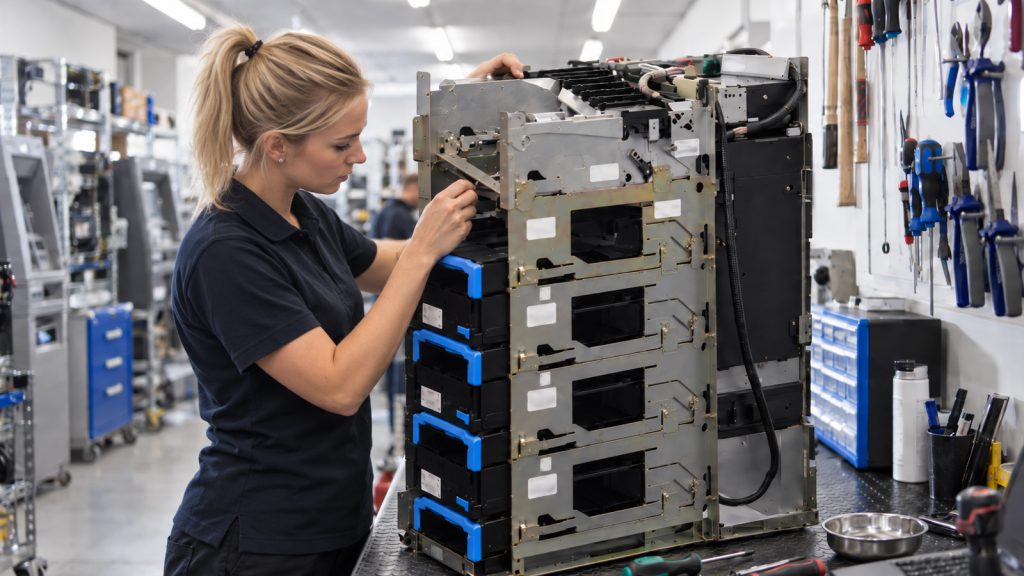
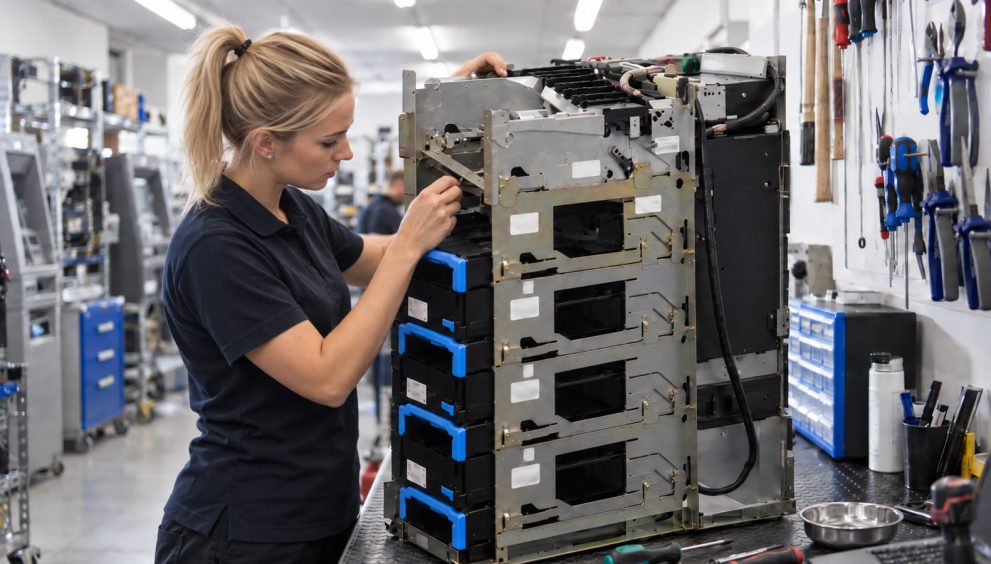
The same problem appears in workshops. A dispenser or card reader may arrive on the bench without the ATM around it. The technician still needs to reproduce the fault, operate the device and confirm that the repair has worked.
Independent diagnostic software fills this gap. It gives service organizations a way to work directly with ATM hardware without depending entirely on the production software or the manufacturer’s normal service environment. Two established examples are ATMdesk, which focuses on NCR platforms, and TestATM, which supports Diebold Nixdorf, Diebold and Wincor Nixdorf hardware. Both address the same underlying problem, although the hardware and service workflows are different.
Diagnostics starts where the error message ends
ATM application software is designed to operate the terminal. It manages transactions, communications, security and the devices required to keep the ATM in service. Diagnostic software has a different purpose. It needs to help a technician understand what is happening inside the hardware.
That may mean checking individual sensors, operating motors or testing a transport path. A technician may need to open and close a shutter, exercise a card reader or run repeated dispense and deposit cycles. In a repair center, the same operations may be repeated many times while a fault is isolated.
This is one reason direct hardware access matters. A device can be mechanically functional while the ATM application reports a communication or configuration problem. The reverse is also possible: a device may respond correctly at the software level while a sensor, transport or mechanical component behaves incorrectly under test.
A useful diagnostic environment needs to separate those conditions.
Field service and workshop repair need different things
In the field, time is usually the main constraint. The technician needs to identify the failed area, decide whether the problem can be corrected on site and verify the repair before returning the ATM to service.
A workshop has different priorities. Individual modules may be tested away from the ATM, often with more detailed access to sensors, motors and internal functions. Calibration and repeated functional tests become more important.
The connection method can also change. Some devices can be connected directly to a service laptop. Others need interface adapters, communication cables or an external power supply. This makes diagnostic coverage more than a list of ATM models. The practical question is how much of the hardware can actually be tested, and under what conditions.
Independent diagnostics for Diebold Nixdorf and Wincor ATM hardware
TestATM is an independent ATM diagnostic platform for Diebold Nixdorf and Wincor Nixdorf equipment.
The software communicates directly with supported ATM devices rather than relying on the production application installed on the terminal. For field service, it can operate from a bootable Linux environment. Installable versions are also available for workshop and laptop use.
That approach is useful across fleets containing several generations of hardware. A service company may be maintaining current Diebold Nixdorf systems while still supporting earlier Diebold and Wincor Nixdorf platforms at other customer sites.
The supported range spans several generations of Diebold Nixdorf and Wincor Nixdorf hardware, including ProCash, CINEO and current DN-Series platforms.
Newer hardware also adds a security dimension. Some devices use authenticated communication, while certain replacement procedures require authorization or pairing. In these cases, diagnostics must understand more than the mechanical state of the module.
For technicians, the advantage of a common environment is consistency. The production software may differ between customers and ATM generations, but the basic service workflow does not have to change with every installation.
NCR diagnostics beyond the OEM environment
ATMdesk provides independent diagnostics for NCR hardware, with separate solutions for field service and repair centers.
Its field-service software runs from a Linux-based live environment on the ATM PC. This separates the diagnostic session from the Windows and NCR application normally operating the terminal. ATMdesk says its field-service product has been available since 2007.
For repair centers, ATMdesk provides a Windows application for testing individual NCR modules on a workshop PC. Depending on the device, adapters may be required to connect the hardware outside the ATM.
The supported range covers multiple NCR generations, including Personas and SelfServ platforms. Current coverage also includes SelfServ 80 and Media Handling 2.0 devices, although some hardware support depends on the ATMdesk software generation and license level.
ATMdesk also supports USB device authorization on compatible NCR SelfServ systems. This addresses a problem that goes beyond basic diagnostics: a replacement USB module may work correctly but still need to be authorized before the NCR application accepts it.
The principle is similar to newer security procedures on other ATM platforms. Modern diagnostics increasingly has to deal with device identity and authorization as well as motors, sensors and communication.
Independent ATM diagnostics remain platform-specific
Independent ATM diagnostics should not be confused with universal ATM diagnostics. NCR and Diebold Nixdorf hardware use different protocols, architectures and security mechanisms. Their device families also have different service requirements.
A diagnostic tool can remove dependence on the production software environment, but it cannot remove these hardware differences. Effective testing still requires detailed knowledge of the platform underneath it.
For multivendor service organizations, diagnostic capability will therefore remain platform-specific. ATMdesk covers NCR hardware, while TestATM supports Diebold Nixdorf and Wincor Nixdorf systems.
That specialization has practical value. A meaningful test requires more than detecting that a USB or serial device is present. The software needs to understand what the module is supposed to do and how its internal components should behave.
Modern laptops meet long ATM lifecycles
ATM hardware usually remains in service longer than the computer environments originally used to maintain it. A fleet may contain equipment introduced across several generations. The technicians servicing it, however, are increasingly carrying current laptops and operating systems.
This creates a less visible maintenance problem. Keeping an old ATM operational may also mean keeping old service laptops, operating-system images, drivers and installation packages available.
Independent diagnostic environments can reduce that dependency. A bootable service environment can avoid the operating system installed on the ATM, while direct module testing can move the diagnostic process onto a technician’s own computer.
This does not eliminate compatibility concerns. Older interfaces may still require adapters, and some devices depend on hardware found only in particular ATM generations. But it separates the diagnostic workflow from more of the software stack surrounding the machine.
Security is now part of the diagnostic workflow
The closer diagnostic software gets to the hardware, the more important access control becomes. Cash-handling devices, encrypting PIN pads and authenticated peripherals cannot be treated like ordinary workshop equipment. Diagnostic access needs to preserve the security model expected by the ATM and its operator.
This is particularly relevant as hardware authorization becomes more common. Replacing a component may involve establishing trust with the new device, not simply connecting it and checking whether it responds.
Service organizations therefore need to evaluate security controls alongside test coverage. The ability to operate a device is useful only when that access is appropriately controlled.
The useful measure is diagnostic depth
A supported-model list is an important starting point, but it does not show how far a technician can go once the hardware is connected.
The more useful questions are practical. Can individual components be operated? Can sensors be observed while the mechanism moves? Are calibration or configuration functions available? Can a repaired module be tested repeatedly before it leaves the workshop?
The same applies in the field. A diagnostic tool should help distinguish between a hardware fault, a communication problem and an issue elsewhere in the ATM software environment.
Service companies evaluating a platform should therefore test it against representative hardware and real failure conditions. A familiar model name on a compatibility list does not necessarily mean every module or service operation is covered.
A separate layer in the service toolkit
Diagnostic tools do not remove the need for OEM software. Manufacturer tools remain important for platform configuration, firmware procedures and other functions tied directly to the OEM environment. Contractual support may also require specific manufacturer processes.
These tools occupy a different layer. They give technicians another route to the hardware when the normal ATM environment is unavailable, unsuitable or simply does not provide enough information. That can be useful on a new platform as easily as on an older one. The issue is not the age of the ATM, but whether the technician can reach the level of the system where the fault actually exists.
In fleet service, remote diagnostics can help identify problems before a technician arrives on site. Direct hardware diagnostics becomes useful when the fault needs to be isolated at device level. The two approaches can therefore complement each other as part of the same service workflow.
ATM devices are becoming more sophisticated, and their security relationships are becoming tighter. This makes direct diagnostics a broader task than before. The tools may remain vendor-specific, but the service problem they address is common across the industry.