




ATM Vendor Comparison Analysis That Matters

A surprising number of ATM buying decisions still start with a spec sheet and end with a service headache. That is why any serious ATM vendor comparison analysis has to look past screen size, cash capacity, and list pricing. For banks, independent deployers, and service organizations, the real question is how a vendor performs across the full operating life of the terminal – from deployment and software integration to parts availability, security updates, and field support.
The market has also become harder to read. Traditional OEMs, cash automation specialists, software providers, and managed service firms increasingly overlap. Some vendors lead with hardware and fill gaps through partners. Others sell a service model first and treat the terminal as one component in a broader operating stack. Comparing them requires a framework that reflects how ATM fleets are actually run.
What an ATM vendor comparison analysis should measure
A useful comparison starts with operating priorities, not vendor claims. A regional bank replacing a legacy fleet has different requirements than a retail deployer expanding into off-premise locations. One may care most about software compatibility and branch transformation. The other may prioritize first-time fix rates, remote monitoring, and speed of installation.
That is why direct feature comparisons only go so far. Two vendors may both support deposit automation, contactless transactions, and ADA compliance, yet create very different outcomes in the field. One might offer stronger parts logistics and better technician training. Another might have a more modern software architecture but weaker service coverage in second-tier markets.
At a minimum, the comparison should cover five areas: hardware platform maturity, software and integration model, service and maintenance capacity, security posture, and lifecycle economics. If one of those is treated as an afterthought, the analysis usually misses the real cost drivers.
Hardware is only the starting point
Hardware still matters, especially for institutions dealing with aging fleets, high failure rates, or branch redesign projects. Build quality, module accessibility, dispenser reliability, recycler performance, and environmental tolerances all affect uptime. So do practical details such as cabinet footprint, UL alignment, and the ease of replacing wear components.
But hardware evaluation needs context. A terminal that performs well in a climate-controlled branch may not hold up the same way in a convenience store vestibule or transit-adjacent deployment. Likewise, a recycler that looks efficient on paper can become difficult to justify if cash forecasting tools and service intervals do not support the operating model.
This is where field data matters more than launch messaging. Buyers should ask how long a platform has been in production, how broadly it has been deployed, and whether major modules have demonstrated stable performance across mixed environments. New platforms can offer strong functionality, but they also carry adoption risk that should be priced into the decision.
Ask how standardized the platform really is
Some vendors present a broad portfolio that appears highly modular, but the installed base may still be split across legacy architectures, region-specific models, or inconsistent component sets. That matters for spare parts, technician certification, and fleet-wide image management.
Standardization can reduce truck rolls and simplify training. It can also create concentration risk if a widely used component develops a recurring fault pattern or faces a supply constraint. The better choice depends on how much operational flexibility the buyer needs.
Software strategy often decides the long-term outcome
For many institutions, software is now the central issue in an ATM vendor comparison analysis. The terminal is no longer an isolated endpoint. It sits inside a wider environment of transaction switching, remote monitoring, key management, cybersecurity controls, and customer experience tools.
Vendors differ sharply in how open their platforms are. Some support a more flexible integration path with third-party software, remote management layers, and multivendor fleet tools. Others work best inside a more controlled ecosystem. Neither model is automatically better. A tightly managed stack can reduce complexity. A more open model can preserve negotiation leverage and support mixed-fleet strategies.
What matters is whether the software approach aligns with the institution’s architecture. If the organization wants to centralize fleet management across multiple OEMs, proprietary limitations become a major factor. If it prefers a smaller number of strategic providers with defined accountability, deeper single-vendor integration may be acceptable.
Security update discipline also belongs here, not in a separate technical appendix. Buyers should examine patching cadence, operating system migration history, remote software deployment controls, and the vendor’s record in responding to newly disclosed threats. Security is not just about encryption and anti-skimming hardware. It is also about how quickly the vendor can help reduce exposure without disrupting service.
Service capacity separates strong vendors from strong presentations
Many procurement teams do a thorough equipment review and a shallow service review. That is backwards. ATM fleets succeed or fail on service execution.
Service evaluation should include direct labor coverage, subcontractor reliance, dispatch logic, parts depots, help desk structure, and escalation paths. A vendor with excellent engineering but inconsistent field response can create more operational friction than a technically less ambitious competitor with disciplined service delivery.
Geography matters. A vendor may perform well in major metros and struggle in rural territories or dispersed retail footprints. It is worth asking for service metrics by region, not just national averages. Mean time to repair, repeat call rates, and parts fill rates become far more useful when they are tied to deployment type and market density.
Managed service models require closer scrutiny
Some buyers want a single provider to handle hardware, software support, monitoring, cash forecasting inputs, and field maintenance. That can simplify governance. It can also blur accountability if service boundaries are not well defined.
When comparing managed models, the key question is not whether the vendor offers end-to-end support. Many do. The question is which elements are delivered directly, which are outsourced, and how performance is measured when multiple parties touch the same incident. Service level terms can look similar while operating realities differ substantially.
Lifecycle cost is more than purchase price plus maintenance
A low bid can become an expensive fleet if upgrade paths are limited, parts become scarce, or software changes require repeated custom work. The better financial lens is total cost over the realistic life of the terminal, including deployment, integration, maintenance, compliance updates, and retirement.
That analysis should reflect expected transaction mix and service intensity. High-volume deposit automation, for example, creates a different wear pattern than basic cash dispense. A terminal placed in a branch modernization program may need stronger customer interface options and software adaptability than a device intended for simple replacement in a stable environment.
Residual value and platform longevity also deserve attention. Some vendors support longer lifecycle extension through parts continuity and sustained software support. Others push refresh cycles more aggressively. Neither position is inherently wrong, but it affects budgeting, depreciation assumptions, and the timing of future capital decisions.
Vendor stability and roadmap credibility
The strongest vendor on paper may still be the wrong choice if its roadmap is unclear or its organizational footing is weak. Financial stability, product continuity, and channel consistency matter because ATM fleets are long-lived assets. Buyers are not selecting a device for the next quarter. They are selecting an operating partner for years.
Roadmap conversations should stay specific. Ask what operating systems are supported now, what migration path is planned, how new transaction types will be introduced, and how multivendor environments are handled. Broad assurances are less useful than version-level detail and deployment examples.
This is also where references become more valuable than demonstrations. Existing customers can usually describe where the vendor performs well, where escalation gets difficult, and how the company behaves when something breaks at scale. Those details rarely appear in formal proposals, but they often determine whether a relationship works.
A practical way to compare vendors without oversimplifying
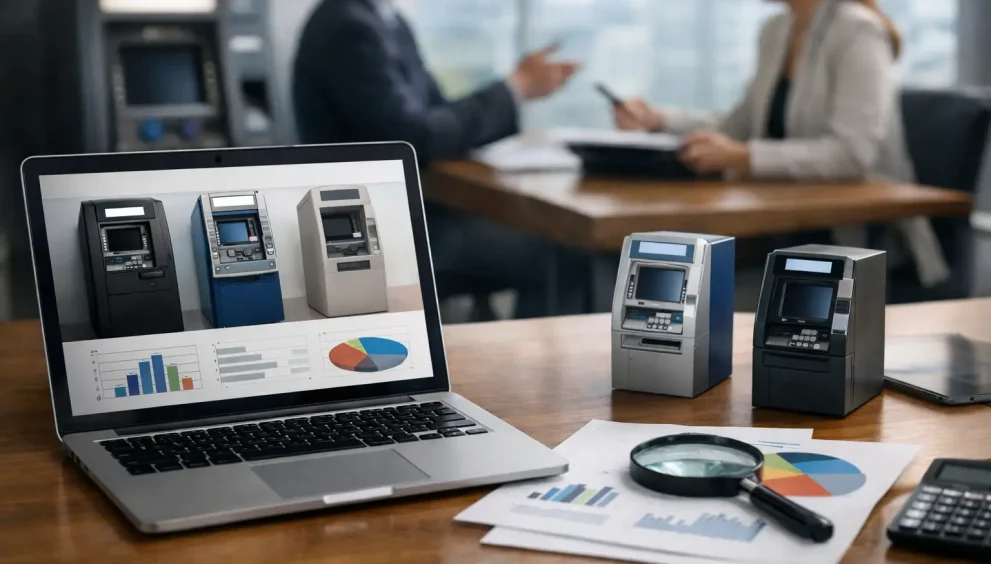
The most effective comparison models use weighted criteria tied to actual business goals. That means defining what matters most before vendors are scored. A bank trying to reduce branch service events should not use the same weighting as a deployer trying to lower install costs across a retail network.
Scorecards are useful, but only if they leave room for trade-offs. A vendor with the best hardware may rank lower on software openness. A vendor with broad service coverage may be more dependent on subcontractors. A lower-cost option may make sense for a short replacement cycle but not for a seven-year fleet strategy.
The point of comparison is not to identify a universal winner. It is to understand which compromises are acceptable for a specific operating model. That is especially true in a market where vendors are converging on baseline features while differentiating on service execution, software flexibility, and lifecycle support.
A sound decision usually comes from combining technical review, field validation, and a realistic reading of service capability. If the analysis stops at brochures and pricing tables, it is not a comparison. It is a procurement shortcut, and fleets usually pay for shortcuts later.
The best vendor choice is rarely the one with the most claims. It is the one whose strengths still hold up after the first major outage, the first software migration, and the third year of routine service calls.