






How to Validate ATM Software Before Deployment

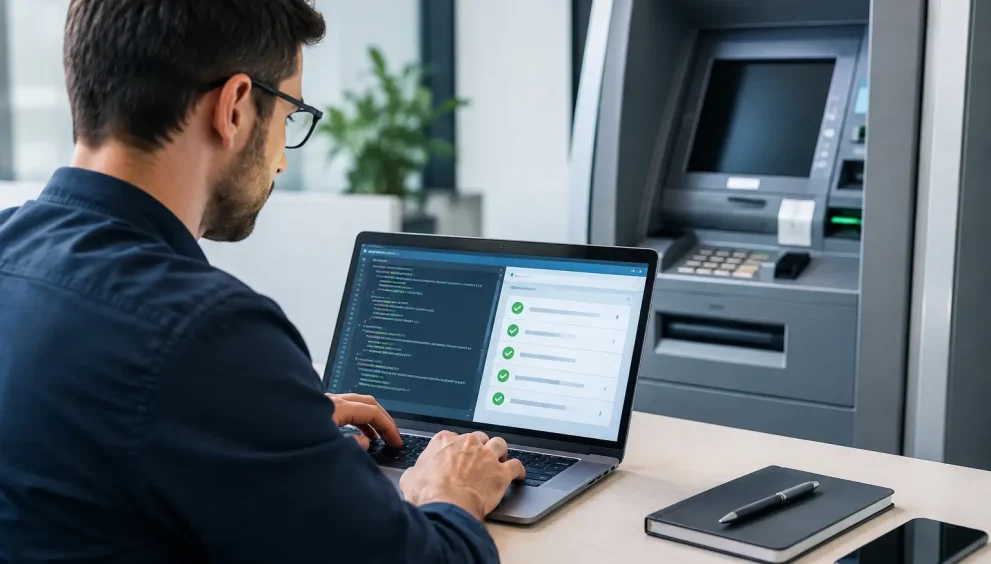
An ATM application can pass a standard transaction test and still fail in production when it meets a different cash dispenser firmware level, a host timeout, or a damaged receipt printer. Knowing how to validate ATM software means testing the complete operating environment, not simply confirming that a screen flow works in a lab. The objective is evidence that the release will process transactions correctly, protect customer and network data, and recover predictably when field conditions are imperfect.
For banks, deployers, and service organizations, validation should be a controlled risk-management process. It has to account for the ATM application, operating system, middleware, device drivers, terminal configuration, host interfaces, key-management processes, and the service procedures that keep the fleet running. A release that is technically sound but difficult to diagnose or restore can still create avoidable downtime.
Start With the Deployment Scope
Validation begins before a test script is written. Define precisely what is changing: an application version, an operating system patch, an XFS service provider, an encryption component, a host protocol update, or a new device configuration. Each change carries a different failure profile.
A minor user-interface revision may require focused regression testing. A move to a new Windows build, a change in middleware, or support for a new recycler normally requires broader testing because it can alter device behavior, performance, event logging, and recovery. The scope should also identify affected terminal types, firmware versions, transaction sets, host processors, and any third-party components.
This inventory prevents a common problem: validating one representative ATM and treating it as proof for a diverse fleet. A fleet with mixed generations of NCR, Diebold Nixdorf, Hyosung, or other equipment may have meaningful differences in dispenser behavior, card-reader interfaces, sensors, journal formats, and supported driver versions. Test coverage should reflect those differences rather than the purchasing plan or asset database alone.
Build a Test Environment That Resembles the Fleet
A meaningful test environment includes production-equivalent terminal hardware wherever possible. Emulators are useful for early development and automated regression work, but they cannot fully reproduce timing, sensor states, device resets, cash presentation, or low-level communications issues.
The environment should mirror the production software stack, including the operating system image, ATM middleware, XFS components, peripheral firmware, terminal certificates, host routes, and monitoring agents. If the production estate uses segmented networks, remote software distribution, or specific endpoint controls, those should be represented as well.
Configuration control matters as much as hardware access. Record software versions, checksums, configuration files, registry settings where applicable, security policies, and device firmware levels. When a defect appears, teams need to know whether it is a software issue, a configuration mismatch, or an interaction between components. Without a controlled baseline, repeated test results have limited value.
Test the transaction path, not just the screen flow
A successful withdrawal is more than a card being read and cash being presented. Validation should follow the transaction across the terminal, network, switch, host, authorization service, and settlement or journal records. Teams should verify message content, response codes, transaction sequencing, reversals, electronic journal entries, and any relevant cash-accounting records.
The same principle applies to deposits, transfers, balance inquiries, PIN changes, surcharge handling, cardless transactions, and other enabled functions. Test cases must reflect the specific services available at the terminal. A capability that is disabled in the pilot environment can become an untested exposure when the same package is deployed to a different terminal class.
Validate the Conditions That Create Real Incidents
Happy-path testing establishes a baseline. It does not establish deployment readiness. The incidents that consume field-service time usually emerge when a component is unavailable, a response arrives late, a customer interrupts the flow, or a device reports an unusual state.
A practical validation plan exercises failure, recovery, and reconciliation conditions such as:
- Host timeouts, declines, partial responses, reversals, and communications loss during authorization or completion.
- Cash-present, cash-retract, suspected partial-dispense, cassette-low, and out-of-service conditions.
- Card capture, card-reader faults, contactless reader errors, and customer abandonment at different points in the transaction.
- Printer offline, paper-low, journal-storage limits, and electronic-journal retrieval after a terminal restart.
- Power interruption, application crash, network loss, and recovery during a transaction or software download.
The expected outcome should be documented for each case. That includes the customer-facing message, host message, device state, journal entry, monitoring alert, operator action, and reconciliation result. Vague expectations such as “ATM recovers correctly” are not sufficient. A technician needs to know whether to clear an error, replenish cash, perform a device reset, reload software, or place the terminal out of service.
Reconciliation is a separate test discipline
ATM teams sometimes validate transaction approval but defer balancing questions until late in a project. That is risky. Cash positions, host records, electronic journals, switch logs, and settlement data must agree after normal transactions and exception scenarios.
This is especially relevant for cash recycling, deposit automation, and transaction flows involving reversals. A terminal can appear operational while generating exceptions that force manual research, create cash disputes, or affect customer claims handling. Validation should prove not only that the transaction completes, but that the institution can explain what happened after an interruption.
Assess Security Without Treating It as a Checklist
Security validation should confirm that the release maintains the controls already required by the institution, network, processor, and applicable payment standards. The specific requirements vary by architecture, but the work generally includes reviewing authenticated software deployment, application allowlisting or comparable execution controls, credential handling, encryption components, certificate behavior, secure key-loading processes, and audit logging.
Terminal hardening must be tested alongside availability. For example, a new endpoint control may block an application dependency after reboot, while a tightened firewall rule may prevent remote monitoring or software distribution. Security teams and ATM operations teams should jointly validate these interactions rather than passing the release between separate approval queues.
Do not rely only on a vulnerability scan. A scan can identify known exposures, but it will not necessarily show that the terminal rejects an unauthorized application package, records a critical configuration change, or preserves transaction integrity after a failed update. Those are operational security outcomes that require scenario testing.
How to Validate ATM Software for Interoperability
Interoperability testing is where nominally compliant components can still create deployment problems. The ATM software must work with the actual combination of terminal model, middleware release, XFS service providers, firmware, host protocol implementation, and management tools used in the field.
Start with a compatibility matrix that identifies supported combinations and explicitly marks combinations that have not been tested. This should include peripheral variants, because two terminals with the same cabinet model may use different dispenser, reader, or printer configurations. If a provider supports multiple host connections or transaction processors, test each relevant route rather than assuming protocol similarity produces identical behavior.
Remote operations also belong in the matrix. Confirm that monitoring platforms receive expected device states and diagnostic events, that remote commands execute as intended, and that software distribution can complete over realistic network conditions. A release that functions locally but fails to report meaningful alerts shifts the burden to technicians and can extend outages.
Use a Pilot to Test the Operating Model
Lab validation reduces technical uncertainty. A controlled pilot exposes operational uncertainty. Select pilot terminals that represent the intended fleet but avoid placing the first release at locations where prolonged downtime would carry disproportionate business or customer impact.
The pilot should have clear entry criteria, success measures, escalation contacts, and rollback authority. Monitor transaction completions, device error patterns, communication failures, cash exceptions, application restarts, and service-call volume. Compare these measures with the terminal’s pre-release baseline where possible.
A pilot is not simply a smaller production rollout. It is a period for testing the support model. Confirm that the help desk can identify the software version, that field technicians have accurate fault-isolation instructions, and that operations teams can retrieve logs and reverse the deployment if needed. If diagnosis requires an engineer to manually inspect several files on every affected ATM, the release may be functional but not operationally ready.
Define Release and Rollback Decisions Before the Window
Validation should end with a formal evidence review, not an informal judgment that testing “looked good.” The release decision should account for test coverage, unresolved defects, known limitations, security findings, pilot results, and whether support documentation is complete. Severity matters, but frequency and detectability matter too. A rare defect that produces an unreconciled cash event may be less acceptable than a visible but recoverable display defect.
Rollback criteria deserve equal attention. Teams should establish what triggers a pause or reversal, who can authorize it, how the previous software state will be restored, and how terminal configuration and cryptographic dependencies will be preserved. A rollback plan that has never been rehearsed is a dependency, not a control.
The strongest ATM software validation programs treat deployment as the beginning of monitored evidence gathering, not the end of testing. Early production data, disciplined exception review, and feedback from field technicians can reveal patterns no lab script will fully reproduce. That feedback should become the basis for the next release baseline, making each deployment easier to evaluate and safer to operate.